Platform comparison
| Platform | YES odds | NO odds | Fee | KYC | Settlement | |
|---|---|---|---|---|---|---|
Polymarket (via Robinhood Prediction Markets) Pick polygram.ink (preferred broker) |
50% | 50% | 0% (USDC on-chain) | No-KYC up to $1,500 | USDC, auto via UMA oracle | Go to the live market → |
Polymarket (direct) polymarket.com |
50% | 50% | 0% | Geo-blocked in US/UK/EU | USDC, on-chain | Go to the live market → |
Kalshi kalshi.com |
— | — | Up to 7% per trade | US-only, KYC required | USD | Go to the live market → |
Betfair Exchange betfair.com |
— | — | 2-5% commission | Full KYC from first trade | GBP / EUR | Go to the live market → |
Manifold Markets manifold.markets |
— | — | Play-money (mana) | None — play-money | Mana (no cash-out) | Go to the live market → |
Outcome probabilities
Current market-implied probability for each outcome, from the live order book.
| Outcome | Probability |
|---|---|
| A | 50% |
| B | 50% |
| C | 50% |
| D | 50% |
| E | 50% |
| Other | 50% |
| BLG | 32% |
| HLE | 26% |
| T1 | 13% |
| GEN | 11% |
| DK | 7% |
| TLAW | 5% |
| KC | 4% |
| WE | 4% |
| DCG | 4% |
| LYON | 3% |
| NIP | 3% |
| G2 | 1% |
| TES | 1% |
| JDG | 1% |
| MKOI | 1% |
| AL | 0% |
| KT | 0% |
| FLY | 0% |
| WBG | 0% |
| TSW | 0% |
| CFO | 0% |
| C9 | 0% |
| IG | 0% |
| GAM | 0% |
| BFX | 0% |
Market context
The market is about which team finishes **first in Riot’s Global Power Rankings after Worlds 2026**, not which team wins the tournament itself. The live Polymarket board currently shows **HLE at 29%** and **BLG at 26%**, with GEN and T1 close behind, so the market is pricing a fairly tight race rather than a single dominant favourite.[4]
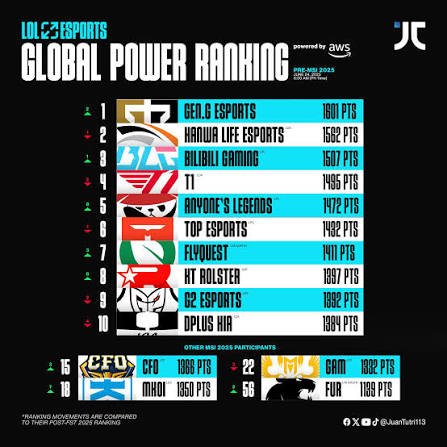
That is consistent with how these rankings have behaved in prior seasons: they are points-based and can move sharply on Worlds results, so late playoff runs matter more than steady domestic form.[4][6] A useful comparison is the current public ranking snapshot, which has **HLE, BLG, GEN and T1 clustered within a narrow band** on third-party Elo-style tracking, reinforcing that the market is reading a crowded top tier rather than a clear gap.[5] For platform comparison, Polymarket shows the price as an implied probability, while Kalshi and Betfair-style books typically translate the same view into contract prices or decimal odds; the economic meaning is similar, but the presentation and take-out differ. Polymarket also publishes the official Riot GPR source for settlement, which reduces ambiguity on the outcome definition.[4]
The main catalysts are Worlds seeding, knockout brackets, and any Riot update to the final 2026 ranking after the event, because the market resolves only when the official post-Worlds list is published.[1][2][4] Traders will also watch whether the last ranking update before Worlds already separates the leaders enough to create a clean favourite, or whether the final event simply reshuffles a packed top four. Access matters too: Polymarket trading depends on USDC on-chain liquidity and is available only where the platform operates, whereas Kalshi is US-regulated with KYC, and Betfair/Smarkets typically quote in decimal odds and may apply different market margins and jurisdictional access rules.
Methodology
We read League of Legends Global Power Rankings Post Worlds: Rank 1 from four platform perspectives: Polymarket (on-chain CLOB), Kalshi (CFTC-regulated exchange), Betfair Exchange (sports book exchange), Smarkets (peer-to-peer betting exchange). Polymarket's live mid is the canonical probability; the side-by-side columns benchmark fees, KYC, settlement currency and deposit rails so you can choose the venue that fits your jurisdiction and trade size.
Resolution & payout
Settlement is the biggest difference between the four platforms: Polymarket on-chain in USDC (instant), Kalshi USD via CFTC (T+1), Betfair and Smarkets in local currency via bank withdrawal (T+1 to T+3). On-chain settlement clears in minutes — the fastest payout path of the four.
FAQ
- Polymarket vs Kalshi — which is better?
- Depends on your location. Kalshi is CFTC-regulated, US-only with full KYC. Polymarket is global, on-chain, no KYC up to $1,500. Polymarket has ~10x higher liquidity but higher regulatory risk.
- What does Polymarket cost vs Kalshi?
- Polymarket: 0% fees, only Polygon network costs (~$0.01/trade). Kalshi: up to 7% per trade plus spread. For high-frequency traders, Polymarket is dramatically cheaper.
- Which platform has the deepest liquidity?
- Polymarket — by a wide margin. Top markets reach $50-500M volume, Kalshi ~$200M cumulative, Betfair similar. Deeper liquidity means your trade moves the quote less.
- Is Betfair a Polymarket alternative?
- Only partially. Betfair Exchange is UK-focused with a sports-betting emphasis; they have politics markets but with thinner liquidity than Polymarket. Settlement in GBP/EUR, 2-5% commission on winnings.
- Which platform supports Klarna/SOFORT?
- Directly: none. Polymarket accepts only USDC on Polygon. Robinhood Prediction Markets offers a fiat on-ramp via Klarna or SOFORT (DE/AT/CH) and converts internally to USDC for the Polymarket order book. T+1 processing.
%22%2F%3E%3Cpath%20d%3D%22M%206%2066%20A%2026%2026%200%200%201%2058%2066%22%20fill%3D%22%23E6B98D%22%20opacity%3D%220.9%22%2F%3E%3Ccircle%20cx%3D%2232%22%20cy%3D%2226%22%20r%3D%2222%22%20fill%3D%22%23F5CBA7%22%2F%3E%3Crect%20x%3D%2210%22%20y%3D%224%22%20width%3D%2244%22%20height%3D%2214%22%20rx%3D%227%22%20fill%3D%22%2314b8a6%22%20opacity%3D%220.9%22%2F%3E%3Crect%20x%3D%228%22%20%20y%3D%2218%22%20width%3D%228%22%20%20height%3D%2218%22%20rx%3D%224%22%20fill%3D%22%2314b8a6%22%20opacity%3D%220.7%22%2F%3E%3Crect%20x%3D%2248%22%20y%3D%2218%22%20width%3D%228%22%20%20height%3D%2218%22%20rx%3D%224%22%20fill%3D%22%2314b8a6%22%20opacity%3D%220.7%22%2F%3E%3C%2Fsvg%3E) and
and%22%2F%3E%3Cpath%20d%3D%22M%206%2066%20A%2026%2026%200%200%201%2058%2066%22%20fill%3D%22%23E6B98D%22%20opacity%3D%220.9%22%2F%3E%3Ccircle%20cx%3D%2232%22%20cy%3D%2226%22%20r%3D%2222%22%20fill%3D%22%23F5CBA7%22%2F%3E%3Cpath%20d%3D%22M%2010%2026%20A%2022%2028%200%200%201%2054%2026%22%20fill%3D%22%2314b8a6%22%20opacity%3D%220.9%22%2F%3E%3C%2Fsvg%3E)
Trade League of Legends Global Power Rankings Post Worlds:… on Robinhood Prediction Markets
Live order book, 0% fees, USDC settlement in seconds.
Open live market →